.png)
.png)
.png)
.png)

Karo Sambhav collaborates with leading organisations to jointly develop industry frameworks, standards, governance mechanisms, systems and processes that advance the transition to circular economy. know more about our alliances.

Close x

E-waste is frequently described as an “urban mine” due to the wide range of potentially valuable materials it contains. Unlike natural ores, however, e-waste is characterized by extreme heterogeneity. This diversity, across products, designs, components, and materials, complicates the recovery of secondary materials and represents a central technical challenge for e-waste recycling systems.
Heterogeneity in e-waste exists at multiple levels. At the broadest level, the term ‘e-waste’ encompasses a wide range of products, from IT equipment such as mobile phones, laptops, and printers to large household appliances like refrigerators, televisions, and washing machines. Legal definitions of e-waste are also continually evolving. In India, for example, regulatory expansions have grown the category to include over a hundred products spanning IT equipment, consumer electronics, medical devices, electronic tools, and toys and sports equipment. As a result, e-waste refers to an extremely diverse set of products with widely varying designs and material compositions.
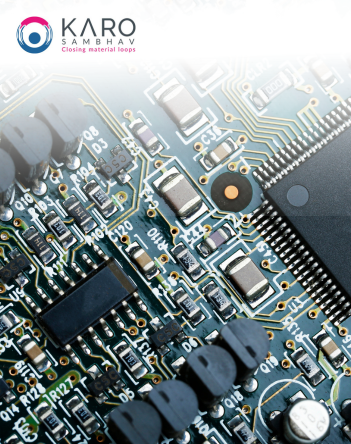
This heterogeneity is also evident at the level of individual products. A mobile phone, for instance, consists of numerous components including screens, cameras, batteries, printed circuit boards (PCBs), and casings. Together, these components incorporate a broad array of materials such as metals, plastics, glass, ceramics, rare earth elements, adhesives etc. Even a single component can be materially diverse; a phone’s outer casing alone may combine aluminium, glass, ceramics, and multiple types of plastics. More complex components such as PCBs are particularly material-intensive, containing over a dozen different materials such as base metals (copper, iron, nickel, tin, zinc), precious metals (gold, silver, palladium), critical metals (indium, gallium), toxic heavy metals (mercury, cadmium, arsenic), as well as plastics, fiberglass, silicon, adhesives etc.
Importantly, neither products nor their components are standardized. Even within a single category such as smartphones, material composition varies significantly by manufacturer, model year, and target market. This is further also true for their components. Rapid innovation cycles further exacerbate this variability, with materials used within the same devices constantly evolving. As a result, recycling systems must process a mixture of older and newer devices with fundamentally different material profiles.
.png)
From a recycling perspective, this heterogeneity creates several technical challenges. First, recyclers must be equipped to handle a vast range of materials. While some of the materials contained within e-waste, such as iron and copper, can be relatively easily processed through existing recycling technologies and established channels to specialised processers. However, others, such as magnets, often lack viable recovery pathways. Second, material variability within a single category of product, such as mobile phones, makes it recycling difficult to predict. Even similar devices rarely contain identical material compositions and can have different ratios in which various materials are used. PCBs, for instance, can be of many kinds, having very different quantities of various materials. Such heterogeneity thus makes it difficult to precisely predict the kind and quantity of materials that can be extracted from one lot of e-waste. Finally, heterogeneity within materials themselves limits high-value reuse. For example, phone casings may use different plastic types across brands and models. These different kinds of plastics are however difficult to separate, resulting in a mixed batch of plastics that must be downcycled into low-value products rather than reuse in high-value products such as electronics.
Thus, while e-waste holds significant promise as an urban mine, its extreme heterogeneity poses a fundamental challenge to efficient material recovery. Material diversity alone, however, does not fully explain the difficulty of recycling e-waste. Beyond containing many materials, electronic products bind these materials together in increasingly complex ways. The next blog explores how this material complexity shapes what is realistically possible and viable to recycle.
About the Authors
Maitreyi Sharan is a PhD candidate at the Oxford Department of International Development. Her current research examines transitions in e-waste management in India. Through her work, she aims to contribute to more sustainable, equitable, and effective waste governance systems.
Pranshu Singhal is the Founder and CEO of Karo Sambhav. Armed with 25+ years of work experience, he has worked as Director, Digital Learning for Microsoft and as Head, Sustainability for Nokia. He was conferred ‘Social Entrepreneur of the Year 2021 India’ award by the Schwab Foundation, World Economic Forum. Pranshu is a member of the World Economic Forum Global Future Councils on Responsible Resource Use. In 2024, Pranshu was appointed as the Vice-Chair of National Working Group-5 of India, International Telecommunication Union - Telecommunication Standardization Sector (ITU-T) Study Group 5.
Additionally, he is an Ashoka Fellow, an Aspen Fellow, a Schwab Fellow, Chevening Gurukul Fellow, an Ikea, and an Aspire Fellow. He has a master's in environmental management and policy from International Institute for Industrial Environmental Economics (IIIEE), Sweden.
Karo Sambhav collaborates with leading organisations to jointly develop industry frameworks, standards, governance mechanisms, systems and processes that advance the transition to circular economy. know more about our alliances.